
F*CKING B*TCH A**HOLE – TOURETTE SYNDROME
Listen to the Sickboy podcast here
Imagine being compelled to do or say the worst possible thing at the worst possible time. This could include shouting the “N word” in your class at school, farting on a date, or yelling “Bomb!” in an airport. It might also include repeatedly banging an injury over and over again or obsessively twisting/cracking your neck (causing pain) well past the point of crying.
This is Tourette syndrome – a neurological auto-inhibitory dysfunction of the brain. It’s a disorder that includes impulsive thoughts and movements that will derail any normally accepted interaction or behaviour you may intend for yourself.
Tourette syndrome itself makes me tic. Tics are repetitive body movements and my most common tics are flipping my fingers and wrists, a slight head jerk, and a ton of unnecessary sniffing. I also have a little bounce in my step. My tics are manageable now because I have years of experience redirecting them to less noticeable body movements, or repressing them, and my impulse control is well developed at my age. It wasn’t always this easy for me though. In high school, however, I ticced so much that I almost fell off my chair a few times. For my stepson, Nate, a 15-year-old boy, impulse control is yet to be mastered. He called his mother “Fucking Bitch Asshole” for about 5 years. Most times he felt bad, but not always. He licked everything you can imagine because his disorder drove him to do it. His manifestations of Tourette are quite spectacular. He would be running across the street, and be forced to lick the bottom of his shoe without losing a step. It was a tic. He has banged, bruised and twitched himself to the doctor’s office many times.
TV Tourette…. A phenomenon most people are well aware of is often the butt of jokes. It’s the “Fucking Bitch Asshole” awkward moment that TV shows follow-up with a laugh track. The uncontrollable swearing that is the hallmark of Tourette is called coprolalia. My stepson and I have that too. Only about 10% of people with Tourette Syndrome have coprolalia. In our house, it can be quite laughable. Our kitchen table at dinnertime can be a barrage of Tourettic coprolalia bouncing from one end to the other in quite a laughable manner. Its not like we could possibly send everyone to the corner for swearing – we would all starve. We have to laugh. But coprolalia is tough too. I’m a professional and I can’t just let things slip out on the school playground or in my office. I have to be on top of it. For Nate, it’s more complicated. Imagine telling your kid’s grade 3 teacher he will most definitely say “Lick my balls”, over and over and call her “bitch”. Yah, it sounds kind of funny, but it’s not when you really think of the implications for daily life. My son’s Tourette-related swearing presents a difficult barrier to fostering relationships at school and elsewhere. It’s a real-life challenge.
Another fact about Tourette Syndrome that you don’t learn from mainstream media is that the disorder almost always occurs with a handful of other disorders (called comorbid disorders). Obsessive-Compulsive Disorder (OCD) and ADHD are the most common, followed by Oppositional Defiance Disorder (ODD) and Learning Disorders – and we have them all. Everyone these days know about ADHD…. It’s the “I can’t stop moving”, “I can’t focus” disorder that can result in abysmally poor impulse control. When this disorder is combined with deficits in inhibition caused by Tourettes, self-control becomes nearly impossible.
OCD is probably the darkest of the comorbidities of Tourette syndrome and one of the most common with Tourette Syndrome. Popular culture often represents OCD as a person who is very neat, perhaps “too neat” and likes things “perfect”. Although these may be traits of the disorder, it’s only the tip of the iceberg. OCD can also include obsessive thoughts that are gruesome or evoke crippling anxiety. These thoughts are constant, sometimes lasting for years. Sometimes they prevent the sufferer from moving forward in their daily lives. They can be truly dark, and even evil. An undiagnosed OCD sufferer is driven to think that they must be an evil person for having such evil thoughts, when the opposite is true. Such thoughts are distressing simply because you know they are wrong and you do not enjoy them. For example, at the age of 4 my stepson Nate saw a fish being gutted and prepared for cooking. Later that day he was inconsolable. Only after lengthy investigation was his mother able to discover that Nate could not stop picturing himself using a knife to “gut” his mother in the same way he saw the fish being cleaned earlier that day. That particular thought/vision remained with Nate for about 4 years and was his living hell. On the advice of his psychiatrist, Nate and his mom learned to treat it for what it was – an intrusive thought and not something he was going to act on. The fact that it was distressing was an indication that he knew it was wrong, and it was not something he would act out in real-life.
There are medications for each of these disorders when they occur alone. Physical tics, OCD and ADHD can all be treated (to a degree) with medication but once again, Tourette presents a new problem. Some medications for ADHD and OCD can cause or increase physical tics. Other medications for ADHD can not only worsen OCD symptoms but they can cause or worsen episodes of rage (another common disorder among people with Tourette).
Being able to find humour in Tourette Syndrome requires a special perspective. It certainly isn’t funny to the person who is struggling to find peace. The constant obstacles that these mental and physical assaults present often force sufferers (of all ages) to a dark place, where there is only exhaustion and no hope. Escaping this place takes years of medical and emotional support. It doesn’t just go away.
I’m not your typical “Touretter”. I’ve taken coping with these disorders to a new level. Not only have I successfully navigated the symptoms of my disorder(s) and the “darkness” they can bring, I have developed strategies that I share to help other sufferers. I have even learned to see the gifts that these disorders can bring. Along with my wife and children, as a collective, we have Tourette Syndrome, ADHD, OCD, Oppositional Defiance (ODD), Learning Disorders and autism spectrum disorder. It’s a pretty interesting family. We may not be like most families, but that doesn’t keep us from being anything but normal. We’ve discovered that normal is in the eye of the beholder. Building on this, my wife and I have created a website to help others find solutions and draw upon the gifts that neurological disorders bring. Our website is neurologicallygifted.com and it’s full of info and advice for individuals, families and educators.
Having learned to successfully manage my Tourette symptoms, I’ve learned to embrace them rather than fight them. I’m able to laugh at them and the “situations” they can create. It has shaped me into a unique and resilient character who is stronger for surviving the continued, daily physical and mental assault of my disorders.

 Coprolalia can occur in Obsessive Compulsive Disorder as well as Tourette Syndrome. People who have Obsessive Compulsive Disorder as well as Tourette Syndrome have a greater struggle as the two disorders may interact with each other and may perpetuate coprolalia. The obsession with performing, (or not performing), the inappropriate behaviour provokes the urge to follow through with it, and vice versa. (see Post:
  People with coprolalia may feel embarrassed and ashamed of their symptoms. There is no will or want to the expression of coprolalia. Often, the response to coprolalia and the lack of understanding and acceptance from other people amplifies the individual’s shame and embarrassment, leading to isolation. Fear of performing the tic in public and being constantly scrutinized and judged may also lead to isolation and depression. In addition, it drives the individual to constantly think about their coprolalia symptoms -What will I tic? -How will I handle it? -How can I suppress it -Who will laugh or stare? -Who will run away? In turn, the stress and hyper focusing will make the coprolalia occur more frequently and intensely. In this way, benign symptoms of coprolalia become malignant due to the stigmatization and judgment of the onlookers.
 Coprolalia, like other tics, is prompted by a premonitory urge. For example, racial slurs may be prompted by seeing a person of a particular race; sexual comments may be prompted by seeing a member of the opposite sex. Seeing these people reminds the brain of forbidden/unacceptable words. Coprolalia co-exists alongside the faulty auto-inhibitory functions within the brain. When faced, for example, with a person of the opposite sex, the person may quickly think “I’d better not say “_______”. By thinking this thought, the individual has put the offensive phrase into their own mind. He/she will then be stuck with the phrase in their head. Coupled with poor impulsivity control, it can appear as if the person is willingly thinking the thought and then saying it without concern for the other person’s feelings. In truth, coprolalia has no relationship or meaning to the observed person and is not a personal attack. There just happened to be something within the environment that prompted that particular urge. For the person with coprolalia, they struggle to prevent themselves from saying or doing the worst possible thing in the particular situation. Imagine having to sit in a church or other place of worship. The mere sight of religious icons evokes meaning in our brains. This meaning cues the brain and conjures words (good and bad). A sufferer of coprolalia will focus on restraining himself or herself from shouting offensive words. This focus will bring these words to the tip of his/her tongue, and eventually out of the mouth. The struggle is internal and far more painful for the individual than those who may overhear the utterance. Coprolalia is not directed at other people nor intended to cause harm or fear in others. Oddly enough, the more a sufferer wants to STOP saying an offensive word, the more likely they are to say it – because of their focus.
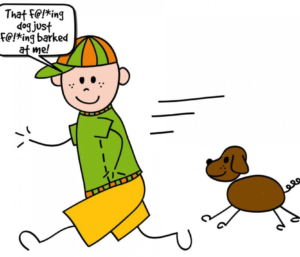 Another confusing aspect about the expression of coprolalia involves the incorporation of coprolalia into regular speech and actions. This phenomenon is more common in children. The urge to say the word may be strong enough that it will occur within the context of speech. The tic is somewhat satisfied for the child, however; it very much appears as being a voluntary addition. Consider the F_ word as a vocal tic that is coprolalia. The child may voluntarily slip it into speech in a fluent way, satisfying the tic but being unaware of how voluntary the tic appears to be to others. For example, “That f_ing dog just f_ing barked at me”. This is very difficult for others (especially parents and teachers) to understand. I remember telling my child, when coprolalia began for him, to just pick one or two of the words and say them out of a sentence so people would more easily identify it as coprolalia! This strategy didn’t work because he doesn’t have the option to choose which tics he says, and because he never really understood why it would make a difference how or when it was expressed. To him, slipping it into speech was more “normal” than randomly shouting a bad word. And doing it my way didn’t satisfy his urge, of course.
 Another difficult characteristic of coprolalia that further impedes understanding is that stress increases tic frequency and intensity. Parents of children with Tourette Syndrome are very familiar with this phenomena. Both negative and positive stress occupy significant mental attention. In these situations, a child has less mental energy to suppress his/her tic symptoms. As a result, more tics are expressed, to conserve mental energy for all the other things that are consuming the child’s mental resources. Consider that anger, disappointment and frustration are major stresses. When a child attends to these negative emotions, they do not expend energy on suppressing their tics or coprolalia. In a situation that provokes strong feelings of anger in the child, tics and coprolalia escalate. In this type of situation, you will have a child who is angry, using inappropriate language, and louder because you have asked them to do something like “Come do your homework now, please.” What looks like a child reacting disrespectfully and aggressively may simply be a child reacting to a strong emotion, increasing tic expression due to the displacement of mental focus to the emotion. This situation is extremely difficult to manage and creates intense stress on families living with neurological disorders.
 “NO!”
“NO!” Oppositional Defiant Disorder responses are deeply entrenched by repetition. To circumvent this roadblock, try going around or get off and take another route! This is one of the general rules in our home. We know that attempting to crash right through Nathan’s “NO”/Stop sign will cause injuries. And, who wants to flatten their child?
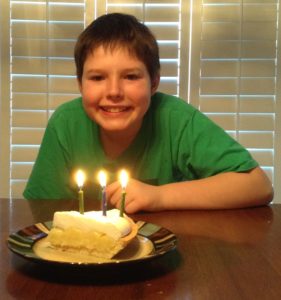 We don’t really know when Nathan’s birthday cake stop sign got placed or cemented there but we all know it is there, so we work around it. This year Nate had a slice of pie. I made cupcakes and we had two kinds of pie. He picked lemon meringue. Candles and everything!